
Beyond You:
When the Business Evolves and You Step Aside

I have been writing blogs based on a chapter in my recent book, The ‘Benefit’ Blueprint for Startup Success. It is about 25 questions every entrepreneur must ask themselves.
This blog brings me to the 20th question. If you want to dive deeper into other questions, please subscribe to my blog.
The question is :
Have I considered how potential exit strategies will affect the benefits provided to customers? How can we ensure a smooth transition that maintains or enhances customer benefits? What measures can be taken to preserve service quality and continuity? Reflect on how different exit strategies might impact customer relationships and satisfaction. How will we communicate changes effectively to reassure and retain our customer base?

What is an Exit
In simplistic terms, it is letting the business evolve without you. Usually, you get some shares, cash, or any incentive that works better for you (you think that way, or you are made to think that way - that means no regrets post-decision).
For the business, exit means evolution, without you. It is a conscious elevation of the company, the team, and the benefits delivered to customers. For founders, stepping aside becomes a catalyst for deeper innovation, greater customer trust, and enduring excellence. Levelling up, if done for the right reasons.
Transitions can portray themselves in many forms:
Introducing a new visionary leadership,
Welcoming new aligned investors or IPO,
Expanding into new geographies, or
Focusing on high-impact strategic roles.
Or, just for completeness
It might be the fugazi that becomes unsustainable ( I have written it for completeness, and as it brings no sustained benefit, we will focus our attention away from it)
Each of these transitions suggests the business’s maturity and its readiness to enrich lives at a larger scale. Making a millionaire and a billionaire is just a modest collateral. One of the companies that I had invested in just exited. In the words of the founder, who is quite young, he is set for life. However, what I saw was a personal transformation he underwent, becoming a self-assured, confident person who was happy to make even a wrong decision if the information at hand justified it. No book could have taught him.
Transitions usually inspire loyalty and confidence. Customers experience consistency with added value. Teams grow in capability and ownership. Brand reputation strengthens through continuity. That is when the ducks line up.
A founder’s greatest contribution often shines brightest when others carry forward the mission with the same care, clarity, and conviction. When purpose is infused into people, systems, and service, the business thrives across generations.
Legacy grows stronger when leadership expands, when the vision is upheld, the experience is enriched, and the founder’s values echo in every customer interaction.

Legacy - Embedding Customer Benefit in Business DNA
Customer benefit goes well beyond something you give. It is something you embody. Long before a transition takes place, the most enduring businesses design their operations, systems, and stories to ensure that the customer experience is baked in.
🧬 Continuity by design.
Think of it like this: if your product or service were a song, your team and your systems should be able to perform it — in tune, in tempo — even when the original composer steps backstage. The objective of the vision statement and mission statement is to ensure such resonance is created, so having an edge is important, not just another copy-paste solution or an endeavour created by AI tools, which may defeat the purpose.
This means:
Documenting what is done, more importantly, why it is done.
Training teams to understand the philosophy behind decisions.
Creating systems where care, quality, and responsiveness are measurable and improvable.
🧠 AI and systems can extend founders’ empathy.
Just been on a presentation by a psychologist on an AI-based solution. AI is advancing rapidly. AI offers memory, learning, and (when used well) the illusion of deep understanding. If trained well, AI can mirror the personal touch (not physically but the day is not far)anticipate customer needs, and offer emotionally resonant service at scale.
This is mass humanised customisation — a blend of AI, data, and personal design that makes customers feel known and valued, at scale.
📚 Suggested read: The Experience Economy by Pine & Gilmore — a powerful framework for designing services that feel immersive, meaningful, and enduring.
The question is not how to preserve your presence, but how to make your presence felt even when you're not present. That’s when the business becomes timeless.

Exit and the transfer of trust
When founders transition, what truly needs to transfer? Beyond equity, operations, or leadership—it's trust(at scale). Trust is carried by processes, by people and by culture.
🏛 Culture shifts, but it shouldn’t vanish.
As a company grows, its culture inevitably evolves. What begins as founder-led improvisation must become team-wide intuition. But the essence — the ethos — must remain.
Think of the Birkin bag. It doesn’t scale like tech, but it holds its essence across generations because of the craft, control and cultural cachet built into every seam. You just can’t scale elegance — you preserve resplendence. And that’s what culture should aim to do.
📌 Shadowing and Immersion:
A master perfumer passes on their nose through apprenticeship, culture transfers best when successors shadow and absorb, not just read or replicate. GE’s former CEO Jeff Immelt once said, “The number of levels in an organisation is the number of years it takes for true change.” Not because it is slow, it takes time to soak. People in change management, please take note.
🧬 The Rise of Voice & Virtual Empathy:
Founders often become the voice of the brand. That voice, today, can be preserved and extended — even cloned — through AI. The goal is never to replace humanity, but to amplify it responsibly. Voice, tone, intent, and philosophy can now be woven into onboarding, chatbots, training, and even video messages designed to greet customers (at scale) long after the founder steps aside. There will inevitably be job losses due to the advent of AI. No different from the industrial revolution that happened in the 1850s. Edge was production at scale then; now it is going to be empathy and emotional connection at scale.
I call this evolving arc “persona sync.” Personality of the brand, protected and scaled without becoming sterile.
🔄 Continuity is the product.
Customers do embrace change, fear, and confusion. When a founder exits, customers rarely ask, “Who’s the new owner?” They ask, “Will I still be heard? Will this still work for me? Will this be better for me?”
If the answer is yes — not because someone says so, but because the system and spirit of the business prove it — then the transition compounds trust.

The soul and scale matrix of exit
Sometimes, a business grows, but the founder’s ( or the core team's) soul doesn’t. It risks becoming a mechanised marvel with no inner compass. Conversely, when the soul expands, but the business doesn’t, it may turn into a temple without followers, full of purpose but lacking the power to serve.
I propose the following matrix to explore four types of exits, based on how much both the business and the founder’s inner growth have evolved:
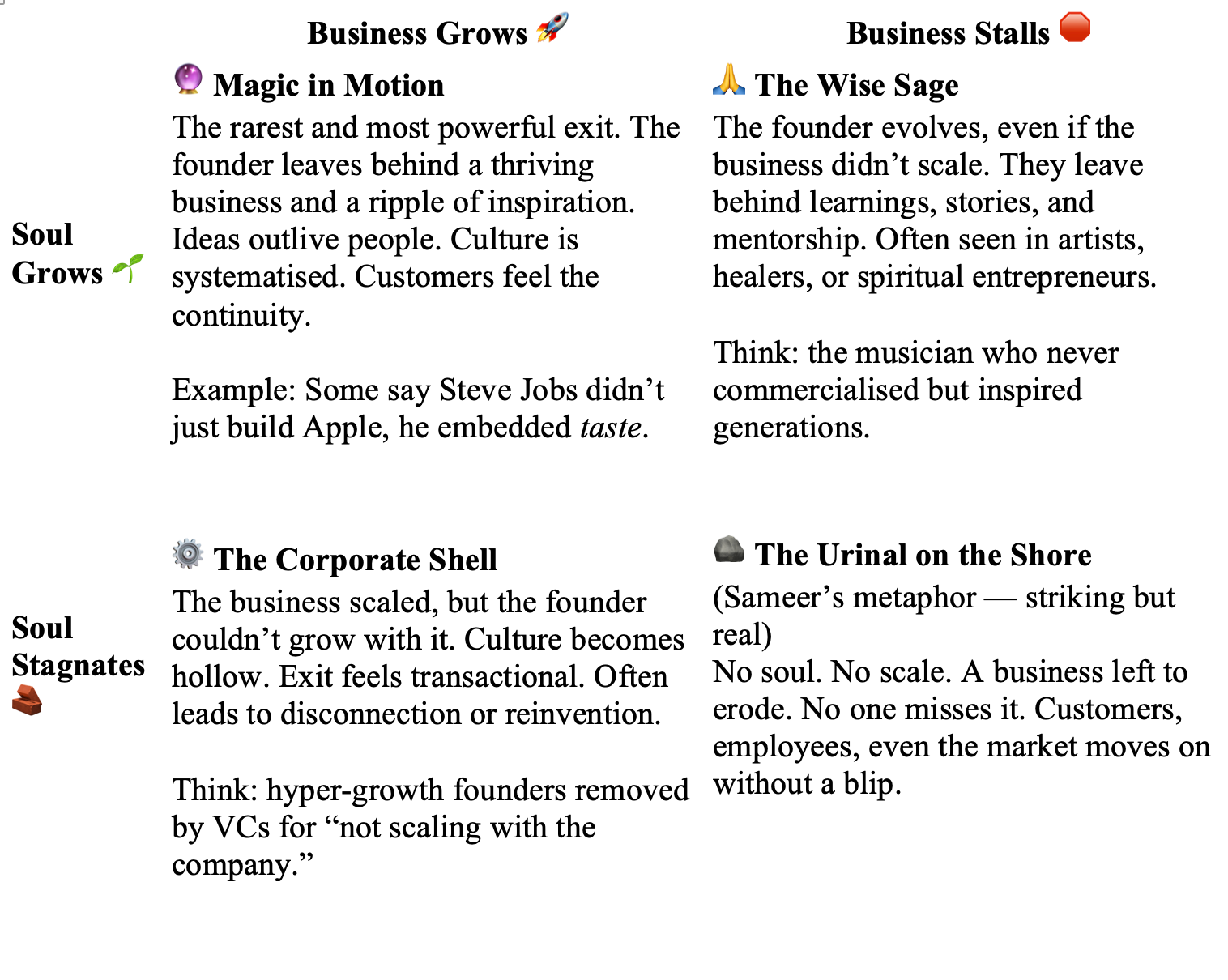
Living Systems, Lasting Impact
The goal is always to exit from the top-left quadrant — Magic in Motion — where both soul and scale rise together. But this can’t be left to happen by chance. It’s a deliberate design choice.
If your systems don’t carry the soul, scale won’t protect you. If your culture doesn’t evolve with you, you risk being remembered for starting something, but not building something that lasts.
The founder's truest legacy is when the business continues to breathe purpose, even in their absence, not out of inertia, but from intention. In that moment, your exit becomes an expansion, not an extraction.
This is the art of ensuring customer benefit through transition — by making your soul transferable, and your systems enduring.

Exit Archetypes and Exit Intentions
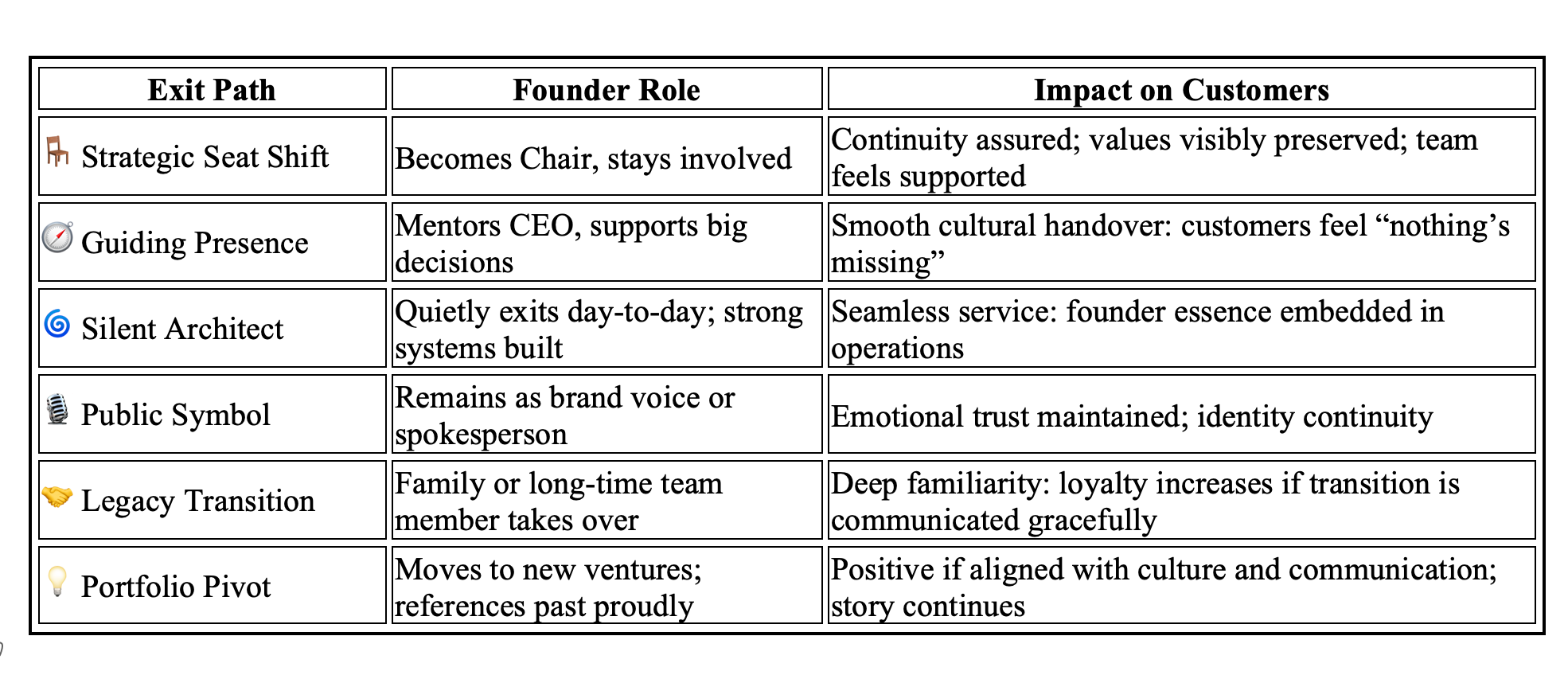
There is no single way to evolve your role in a business. What matters is whether the customer experience remains whole, whether the relationship your business has with people is strengthened, weakened, or left adrift.
The most effective founders design exit based on alignment with their energy, the business stage, and the experience they want to leave behind. A founder recently exited. He was pitching his services to a much larger business. His positioning was based on the service he was offering. He also added how his business as a whole will be good. There was so much awe that he got an offer to be acquired just following the presentation.
🎭 Founder Exit Archetypes
Every founder exit leaves an imprint.
Whether you step aside with a bang or blend into the background, your chosen path shapes how your customers, team, and brand evolve. These founder exit archetypes are practical frames to anticipate emotional upheaval and operational continuity.
In each, there’s a silent handshake between legacy and leadership.
Understanding these archetypes helps ensure that your departure deepens trust, gives your team a map, your customers a story, and your mission a future.
When done with intention, an exit is a new beginning.
An expansion.
🌱 A founder’s growth a vital ingredient for scaling
Something I learnt during Vipassana Meditation holds true for one’s growth and is a timeless wisdom, “Often fast growth inflates the ego, making founders believe the success is entirely theirs. But many rides are just waves. Reflecting on both success and failure with equanimity is vital.”
Success and failure are both visitors — meet them with equanimity.
Communicating Change with Care
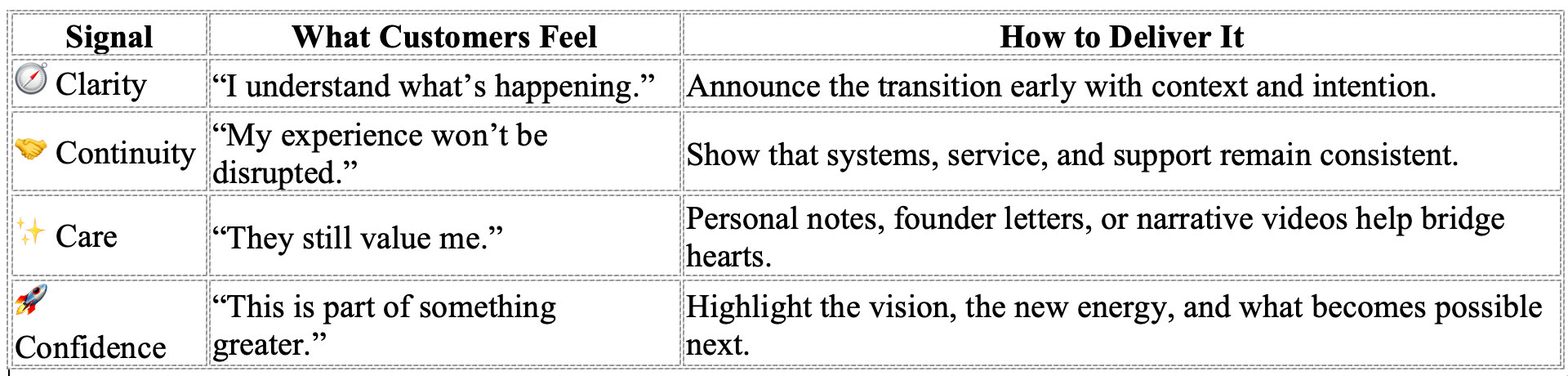
Customers rarely fear evolution; they fear uncertainty. When the change feels invisible, silent, or sudden, it is very unsettling.
Great businesses grow because they make people feel something — clarity, relief, possibility. That feeling must continue, especially when the founding voice begins to shift into a wider choir.
🛠️ Communicating Through Transition: The Four Reassurances
To maintain trust during a founder’s shift in role or visibility, customers look for four emotional signals:

The Legacy Loop: Customer Benefits Outlive Founders
Deepening Impact, Not Departure
Imagine stepping back from your company only to see its positive impact on customers continue to grow. In this vision, legacy is about deepening your idea’s impact in your absence. A founder’s true legacy is written in how well the mission thrives beyond the founder’s tenure.
When an idea truly resonates, it becomes larger than the individual who started it. As one innovation leader observed, if your idea is great, “it’s bigger than you… more minds, more collaborators will shape it and grow it… It will become something much bigger than yourself.” In other words, success means your vision can take on a life of its own.
The founder’s role then evolves from being the sole driving force to being a catalyst for others, allowing the company’s purpose to expand with fresh energy. This mindset transforms an exit from a loss into a multiplication of influence.
Positioning legacy as an ongoing impact also helps avoid viewing an exit as an ending. Instead, it’s a continuation of the founder’s values through new hands and minds. Consider this gentle prompt: If your business can’t survive without you, is it a success?
Phrased differently, if everything hinges on one person, customers ultimately miss out on the strength of a broader team carrying the torch. By ensuring your business stands on solid cultural and systemic foundations rather than on your persona alone, you turn your legacy into a platform – one that others can stand on to keep delivering the benefits your customers love.
The legacy loop closes only when your departure actually deepens the customer experience, proving that your idea was always more than just you.

Culture, Systems and Voice: The Pillars of Continuity
How can you ensure that customers continue to feel the same trust and value when leadership changes?
The answer lies in the continuity of culture, systems, and voice.
It’s the company’s DNA beyond the founder’s presence that should be delivering customer benefits. A well-defined culture, reliable systems, and a consistent brand voice form the safety net that catches customers during transitions.
These pillars ensure that what customers experience day-to-day remains familiar and reassuring, even as names on the organisational chart change. When values are deeply ingrained in your team and processes, a new CEO or owner doesn’t spell upheaval for customers. Instead, customers perceive stability: the service stays prompt, quality remains high, and the tone of communication feels the same as before.
Key elements to maintain this continuity include:
Culture: Clearly articulate and instil the company’s core values and customer-centric ethos in every employee. A strong culture acts as the invisible hand guiding decisions when the founder is no longer there to decide.
Incoming leaders should embrace the established culture to ensure continuity, respecting the company’s traditions and values. This way, the organisation’s heart – its purpose and principles – keeps beating steadily.Systems: Scalable systems and processes carry the founder’s way of working into the future. Well-designed customer service protocols, knowledge bases, and product roadmaps mean that customer benefits are delivered through robust mechanisms, not personal heroics.
These systems allow consistency; as a result, the company can adapt to growth or change without betraying customer expectations.Voice: The brand’s voice and narrative should remain consistent and authentic. Whether in marketing messages, support calls or community forums, maintaining the same voice that customers associate with your brand builds trust.
Many companies develop a “voice guide” so that even new team members speak to customers with the tone and empathy the founder championed. This continuity of voice reassures customers that “the soul of the brand” is intact, even if the author of that voice has changed.
When a leadership transition is on the horizon, smooth succession planning becomes crucial. Often, identifying a successor from within who already lives the culture can greatly ease customer concerns.
For example, Zoho Corporation recently underwent a leadership change that showcases continuity in action. Its founder, Sridhar Vembu stepped down as CEO after nearly three decades, but intentionally shifted to a Chief Scientist role to focus on innovation.
He ensured his continued presence would “keep the company’s core values and innovative spirit intact,” guiding strategy and nurturing the R&D culture. In parallel, a long-time co-founder took on the CEO mantle. This kind of planned transition sends a clear message to customers: the values that built their trust aren’t going anywhere.
New leadership, same compass. Customers of Zoho see the company still thriving with fresh energy, while the familiar vision continues to steer from the background. Such continuity in culture and voice means the customer experience remains seamless through the change.
Transparency and communication also bolster continuity. Proactively inform customers about what’s changing – and more importantly, what is not changing for them. Reassure them that product quality, support responsiveness, and the mission remain steady. When customers hear from the company (or the departing founder) that “you will continue to get the service you love, and here’s why”, it creates confidence. Some founders pen thoughtful open letters to users during transitions, striking a reassuring tone that the customer’s journey will only get better. Framing the change as a positive evolution – “a new chapter for even better solutions and care” – helps customers feel included in the journey rather than alienated by it.
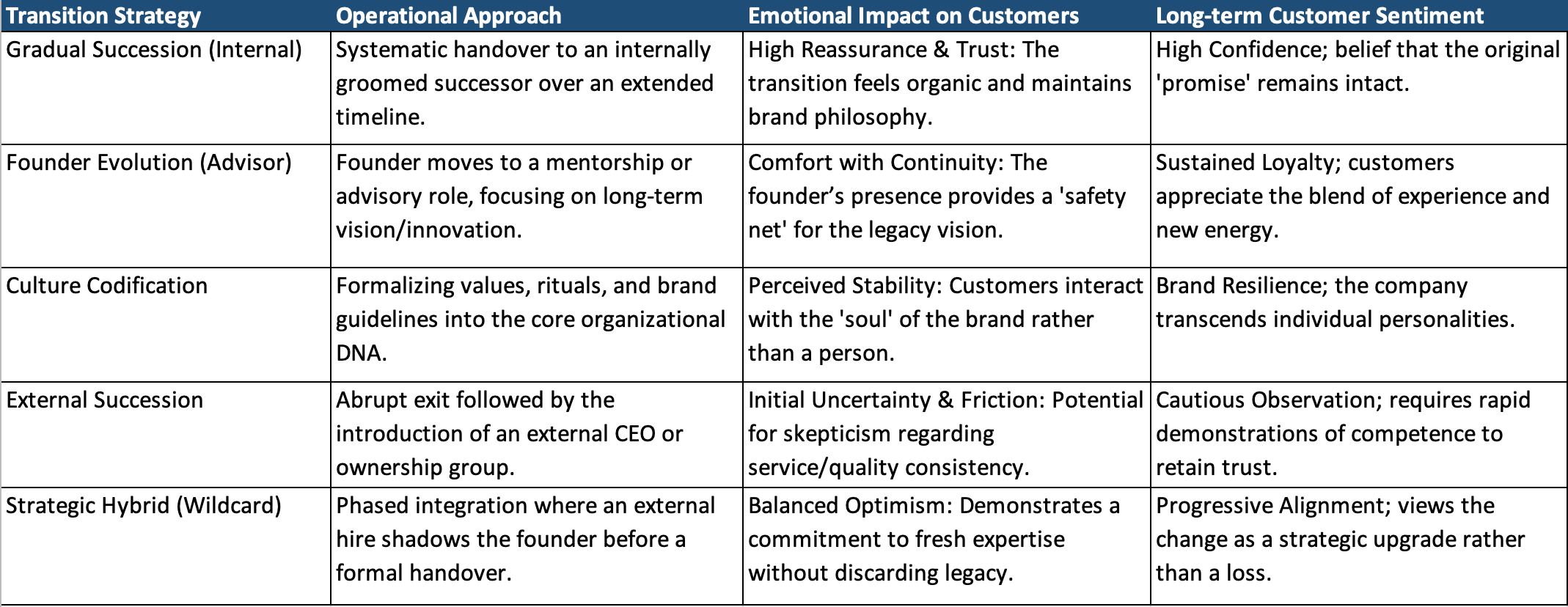
Transition Strategies and Customer Connection:
To illustrate how different approaches to leadership or ownership change can influence customer emotions, consider the matrix below. It summarises a few transition strategies alongside their likely emotional impact on customers:
Legacy as a Living System: Your Final Gift
A business that lasts is one that learns how to breathe without depending on one pair of lungs. When customer benefits are embedded into the DNA of your systems, people, and story, your presence transforms into principle.
Legacy is the expansion of impact through others.
Your role as founder shifts from centre stage to steward of continuity. And the business? It rises into a vessel of values that outlives a single voice. Customers continue to feel heard. Teams act with confidence. And the brand doesn’t just survive — it resonates.
As someone who has advised, built, and grown with founders across the world, I’ve seen it clearly:
The strongest legacies aren’t loud.
They’re felt quietly, in every small moment of customer trust that never breaks.
🌿 A Quiet Invitation
If this reflection sparked something — a question, a nudge, a roadmap for your own evolution — I invite you to reach out.
There’s no pitch here. Just conversation. Thought. A guide, if needed.
Because stepping aside doesn’t mean stepping away.
And every founder’s journey deserves a thoughtful next chapter.
✉️ Connect via sameerbabbar.substack.com or message me privately.
If this piece could help someone you know navigate transition, please share it.
Legacy expands when ideas are passed on.

© Sameer Babbar
If you would like my ideas mailed to your Inbox first, please also join me on my Substack
Disclaimer: This is for information only. It does not consider your objectives, financial situation, or needs. The author, his company, his associates, his directors, his staff, his consultants, and his advisors do not accept liability for any loss or damage, including, without limitation, any loss that may arise directly or indirectly from the use of or reliance on the information provided